Tuesday, 2 September 2014

TLC 1 - Providing Challenge to promote Resilience

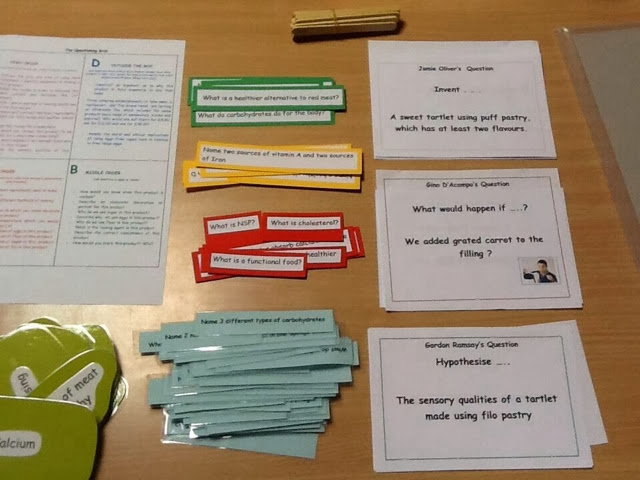
The first TLC of the year was a brief introduction into the focus area of 'providing challenge to promote resilience'. The first activity to get staff members warmed up and ready to go was a solo taxonomy starter, an example of how challenge can be incorporated into lessons. The idea is to set tasks at different levels so students can approach them dependent on their ability. This example involved profiteroles! The first solo station starts with an image and a question, I.e. What are they? The second station then progresses to a definition and the type of pastry involved with making profiteroles and so on and so forth and dependent upon ability, students and in this case, staff, can progress accordingly.

The aim of the first meet was to gauge what staff do to promote challenge in their lessons and then discuss and share ideas and research new ones following links and suggestions given from the Challenge TLC leaders. Our aim was to ensure that the Challenge TLC members commit to 3 Challenge strategies to incorporate into their lessons before TLC 2. TLC 2 will enable the TLC members to reflect on the success or the failure of the strategies tried within lessons and share good practice between each other.

Examples of the activities from Challenge TLC 1:


Monday, 1 September 2014

Tour of TLC 1 - 2014-15

This year the TLC programme has split. All staff will complete two cycles with each with a different focus. 

TLC 1 is an opportunity for staff to be introduced into their chosen area for instance “improving quality of 6th form teaching”. Triad cross-curricular groups will have the opportunity to research and plan new ways that their focus can be improved to have impact upon learning. 

As usual I ( David West, Leadership Secondment as a Lead Teacher ) will take a tour of the TLCs and report in this post what is happening. My aim is not to provide a overview of each TLC (this will be done by each of the TLC leaders after the session) but to provide a snapshot of what is being discussed and the activities being undertaken in the time I am in each TLC.

Technology/ipads to promote student responsibility.
As I arrived staff were using QR codes to read blogs and searching for the benefits and drawbacks of technology and thinking about how they could apply what they have read to their own practice.


As I arrived later on staff were setting targets for the next TLC and posting these on Edmodo. The importance of personalising the targets was emphasised to ensure that the whole group of staff had the chance to make progress against their target.


Consistent use of feedback/DIRT to improve student reflectiveness.
As I visited this TLC staff were discussing what effective marking looks like in their lessons and what the potential pitfalls can be. I witnessed a really interesting debate on what sixth form students do with the feedback they have received and how to maximise the impact of the time spent marking.

Staff then looked at a matrix of marking and tried to work out which piece of feedback fitted which element of the matrix.


Providing challenge to promote resilience.
Using a starter to differentiate the group staff then used solo taxonomy to look at the their current practice and to think about what they hope to get out of the session.


Progress for all (particular PP)
As I arrived in this TLC staff were discussing how a focus on pupil progress can help pupil premium students. One group talked about the importance of treating students as individuals and having the correct information to hand to help work with them in a more directed way. Another talked about making up for a potential lack of support at home. 

Improve independence and responsibility through 6th form teaching.
As I arrived in this group they were looking at some sixth form student voice. The staff then looked at potential surprises and how the results of the student voice could effect their lessons. The importance of personalising learning within a mixed ability classroom was raised.
Staff then looked at some potential ideas of how sixth form work could be developed and whether these ideas could work in their lessons.


Overall Reflections
The atmosphere within the TLCs was excellent. Staff were sharing good practice and listening to ideas and thinking about how they could incorporate them into their own lessons. For the first morning of the new term it was incredible.


Wednesday, 30 April 2014

TLC 5 & 6 - Preparing for the Learning Fair

The aim of part of TLC 5 and all of TLC 6 was to allow the staff @Rossett to prepare for the learning fair on the 24th June. The Learning Fair will be an opportunity for faculties to showcase the impact that the TLC focus on Questioning, Differentiation and Feedback has had on the learning within each faculty.

During TLC 5 faculties were given time to begin to plan for the Learning Fair and during TLC 6 staff were given time to produce resources that showcase the impact that the focus on these three strategies has had. Below are brief outlines of what each faculty is planning.

Maths
Feedback - Stuart, Adam, Carolyn
Examples of work regarding the use of feedback stamps, grade cards, feedback folders, games used within lessons will be in three areas to look at the different activities used. Staff will create videos which will be played on a loop to explain how giving feedback has impacted their teaching and learning and how they activities have been used in class. Edmodo and neopod apps will be used.
Questioning - Tom, Tracey, Karen
Posters will be done to show questioning style a used in maths, such as odd one out and here is the answer, what is the question? Activity area will look at a student question generator for staff to participate with.
Differentiation - Ian, Elaine, Dilbar, Philippa
An area with examples of differentiated work from students and lessons with visual aids to display. An activity on GCSE graded equations will be shown for staff to participate in. The higher grade equation you achieve, the more raffle tickets you earn. At the end of the fair the raffle will be drawn and prizes (maths set, chocolate) will be awarded.

English
In the faculty of English, the overall impact of TLCs has been an improvement in work- we are seeing better outcomes. There is clear evidence of students making progress. The differentiation group thought that what they have taken from their sessions has helped  improve focus and whole class engagement. The strategies are enabling the academically more able to stretch themselves and have also been proving useful for EAL students. In questioning, colleagues were discussing the range of strategies that they are now aware of, made possible by the sharing of practice. Questioning in different ways has led to deeper engagement from students and deeper reflection by staff on the questions that we are asking. Finally, the feedback group reported improved quality of work, the feeling that marking is being acted on more effectively and that students are taking feedback on board, rather than just looking at their marks. Educational apps have helped staff to give feedback in a range of ways.


MFL
In tonight's  TLC we started with a recap of how the faculty had been incorporating feedback, differentiation and questioning into their teaching.This involved also revisiting the MFL D.I.R.T Strategy where a number of targets were set as a group from out last TLC. One to note was the use of verbal feedback stamps which could be used during lesson to give feedback to students to act upon immediately. This target has clearly been embedded into the faculty and all staff could provide evidence of this within students exercise books (See pictures).

We then started to revisit our ideas for the learning fair in June. This included confirming activity choices, assigning job roles, creating and collating resources. The remainder of the TLC was spent creating these resources in micro groups. The activities in which the faculty have chosen clearly identify questioning, feedback, and differentiation through a number of fun, engaging and challenging activities. All will be revealed by the MFL faculty on 24th June.


Social Sciences
The social science faculty have split into their three groups: feedback, differentiation and questioning in order to produce individual visual/ physical displays for the learning fair. The feedback group are using the concept of an archeological dig through the 'dirt' to find various examples of feedback and videos of students discussing the impact this has had through the use of QR codes. Furthermore, various presentations and physical examples will be on display. Questioning idea resources that have been used in the classroom will be accessible for other faculties to view and try out. Finally, differentiation ideas will be displayed visually and teachers can have a go at learning to juggle using differentiated instructions. The aim of all of these presentations and activities is that all will be self-explanatory or left with clear instructions so staff can just 'have a go' whilst visually realising the impact that these three concepts have had on the faculty's teaching and learning.

Access and Inclusion 
The staff in the access and inclusion faculty have been working around the three themes of this years TLC for many years. They are planning to showcase a collection of established practice built up over time and new practice influenced by this year's TLC programme.
+ At the learning fair A&I will showcase the impact effective questioning can have on students with autism. This will be done through examples and Jenga.
+ They will use Lego therapy to showcase how to effectively differentiate a group activity by showing how effective Lego therapy is at developing weaker students and stronger ones at the same time.
+ They will look at the impact that feedback techniques have had on the learning within both the Bridge and the Literacy Workshops that take place within the A&I faculty. Student's will discuss the impact that feedback has had on them in short video entries.

Design and Technology
Questioning
Questioning is differentiated and used effectively for revision and important information. The approach is very creative and engaging, including colour-coded Jenga, magnetic darts and Guess Who games.

Students work in small groups on different games. So far students have been engaged and enthusiastic and it has helped them to remember key facts.

Questioning is differentiated and colour-coded. 'Top Trumps' cards are also used.


Feedback
DIRT time is used to help students at all key stages make progress with practical work and is very student-focused. Clear indications of when targets have been met have helped students show progress.


Peer assessment has been adapted to be more subject-specific.

Differentiation
Clear step-by-step instructions with visual aids support students of all abilities in practical lessons.
QR codes are differentiated and placed around the room so students can easily access the most suitable resources for their target.


Differentiated learning outcomes are used in lessons, including colour coding and linking to grades and levels. This has helped students be more aware of what they need to do to achieve their target levels/grades. 

Science
Differentiation
Our differentiation group have focused in the following areas within Science:

Stretching the most able year 7 through open ended research which will contribute to a CREST award.

Supporting EAL students through Science specific vocabulary look at the impact Liz Edward’s has had with this year 8 EAL student:


Differentiated learning outcomes so all students are provided for in the lesson.

Graded socrative quizzes so students get instant feedback on the grade that they are working at.
5.
SOLO taxonomy in Science so that students can progress at different rates.

Feedback
Our feedback group have focused on the following areas in Science.

eFeedback through Google drive this has proved to be an excellent method of feedback for our BTEC scientists.  All the students concerned have all be able to improve their work through the feedback provided over the Google drive.

James Lee has been pioneering the use eFeedback by recording himself working through exam questions.  Watch James’ latest video on the following link:
http://www.educreations.com/lesson/view/biol-5-june-13-q2-resp-muscles/20745820/?s=KzGPaG&ref=appemail

Pip Bromhead has developed a Science DIRT template to be used in DIRT lessons, initial feedback from students has been very promising.
Questioning
Our questioning group have concentrated on the areas below:

Majella Fergus has been working on Question Formulation Technique which a method of improving students own questioning.

Students have been creating their own exam style questions and working with other members of the class to get the best answers.  

We have designed Science specific question loops.

Watch out for Gavin Davies the question monster at the learning fair whose ‘brutal’ ways are helping develop the scientific thinking skills of the Rossett students. 

Saturday, 18 January 2014

TLC 3 - Differentiation group

TLC 3 - Differentiation

This was the final opportunity for the three TLC groups for differentiation to meet and discuss what they had used or tried within thelast few months in lessons. The session started with a starter of quiz, quiz trade to connect the learning to previous work.


Following this staff were asked to get into departments and create small presentations on all differentiation strategies they have used within lessons to share with other departments in the session.


Departments used a range of apps or presentation tools to create resources for others to share within the sessions. Presentation tools used were: Popplet, powerpoint, explain everything, imovie. Screen shots are shown below of the various presentations.


To end the session we asked staff to Tweet out and share any strategies they have learnt today or ideas they would like to try out in future lessons.


Tuesday, 7 January 2014

A tour around the TLC's (TLC 4)

The aim of TLC 4 is to bridge the gap between the TLC's that have just gone and the TLC's that are to come. The first three TLC's were based around cross-curricular groupings. They involved staff working closely with other members from different faculties within the school. The last three TLC's (after today) are set up in faculties with colleagues working together with members of their own faculty.

As usual for this academic year Rossett staff are working around one of three important themes:
+ Questioning
+ Feedback
+ Differentiation

The aim of today's session was to allow staff to produce a presentation to showcase the progress that they have made so far with their chosen area. The example below comes from the questioning group.
 

Questioning
The questioning group began with a quick game of 'Who am i?' To connect the TLC to the topic of questioning. Staff were engaged in the activity and adopted creative approaches to help find out who was stuck to their heads.

The staff then focussed on the different questioning techniques they have successfully used already. They wrote them on a post it and then stuck them to the Keep Calm and Reflect board.

Staff really looked to focus on the impact that their work so far has had on teaching and learning.


Feedback
The feedback group began with an anagram competition to connect the TLC to the session. The staff were really engaged in the activity. Some staff were even using iPads to help them (some staff accused them of cheating) work out that CLOSING THE GAP was the theme.

The feedback group delivered more formal presentations showcasing how they have developed their use of feedback. The enthusiasm for the topic was evident from both presenters and those watching. Using digital methods to present to the group allowed for all the group to review the presentations at a later date.


Differentiation
The staff began with a QuizQuizTrade Kagan activity to connect the TLC to the session. The cards contained the key themes of the session and allowed the staff to all focus on the progress they have made so far and how they would develop their ideas in the coming term.

The staff then discussed their work so far with members of their faculties and produced short micro presentations, in a learning fair format, to show the progress made so far and where they need to go.

The differentiation group also used a learning fair style to allow all the staff to walk around and see what each other faculty has done so far and the impact it has had.
Again the quality of what was shared was outstanding and a lot of the staff commented to each other about how much they've learnt from sharing in the session.

Conclusions

The atmosphere within the TLC's was again exceptional. The quality of what staff were sharing really stood out as did the openness with which they shared their ideas. 

"I've actually stolen part of this from Rob."

"I've forgotten that I used to do that but now I've seen how you've used it I'm going to try it again."


All three of the sessions were fantastic examples of the quality of the staff @Rossett and the quality of the work they are doing in their lessons. All three sessions were buzzing with excellent pedagogy and good ideas. 

The start of the term felt like a fantastic time to be sharing in this way.


Thursday, 5 December 2013

TLC 3: Questioning

Micky, Kaljit and Kirsty. A really positive session presentation focussing on resources and tools which enable teachers to clearly establish understanding as well as allowing learners access to differentiated levels of the lessons.
https://pic.twitter.com/U6ygfcCSLj
https://pic.twitter.com/MUEQ84GkFE
https://pic.twitter.com/PVcGJYZT8K


Brendan and Sue shared a wealth of ideas including question formulation technique and solo stations:


Gavin, Jo and Huw presented an interesting combination of fun and engaging traditional strategies, with kinaesthetic techniques designed to engage challenging learners as well as web based questioning solutions.


/sites.google.com/site/inquirymaths/home/Picture2.png
http://www.inquirymaths.com/home/Regulatory-cards

 Overall a great session with a combination of inspiring resources and ideas. One last one from me...

TLC 3 - Questioning - Dan Bird's group

This was no the third and final opportunity for the this group of staff to collaborate and share their experiences of questioning. An opportunity to discuss what they have experimented with and the impact that this has had on both their teaching and learning within the classroom.

PAIR REHEARSAL


This method allows students to work with their table or shoulder partner to discuss and agree a response before answering. As a result of allowing this additional time for students to collaborate their answers students feel more confident in their responses as well as offering a more detailed responses with higher order thinking. It is also clear that it increases student engagement and interaction.

ENGAGEMENT CARDS


This method puts the emphasis back on the student to either pose a question or offer and answer, of merit, within the lesson. This 'challenge' creates and environment where students think carefully about the quality of any questions that they may ask as well as the quality of their responses. The cards create a focus for the students, creating an emphasis on quality rather than quantity.

POSE-PAUSE-POUNCE-BOUNCE

This method places emphasis on the teacher to allow enough thinking time for students to generate an answer before pouncing on a student for a response. The impact this has on learning is an increase in student engagement as well as improved student response. After pouncing on a student for a response, the model requires a bounce to another student to improve and develop the answer previously offered.


Onwards to the next meeting on the 7th January 2014, where staff will be able to share this practice with members of their own faculty.